

From EVs and batteries to autonomous vehicles and urban transport, we cover what actually matters. Delivered to your inbox weekly.

On a busy street in central Paris, traffic has slowed to a crawl. Big cars block intersections. Delivery vans stop wherever they can. It’s tight, noisy, and stressful. But then, something unusual happens. A tiny electric vehicle pulls up. With the press of a button, its body narrows by 30 centimeters. It slips between the cars and parks in a space barely wider than a motorcycle.
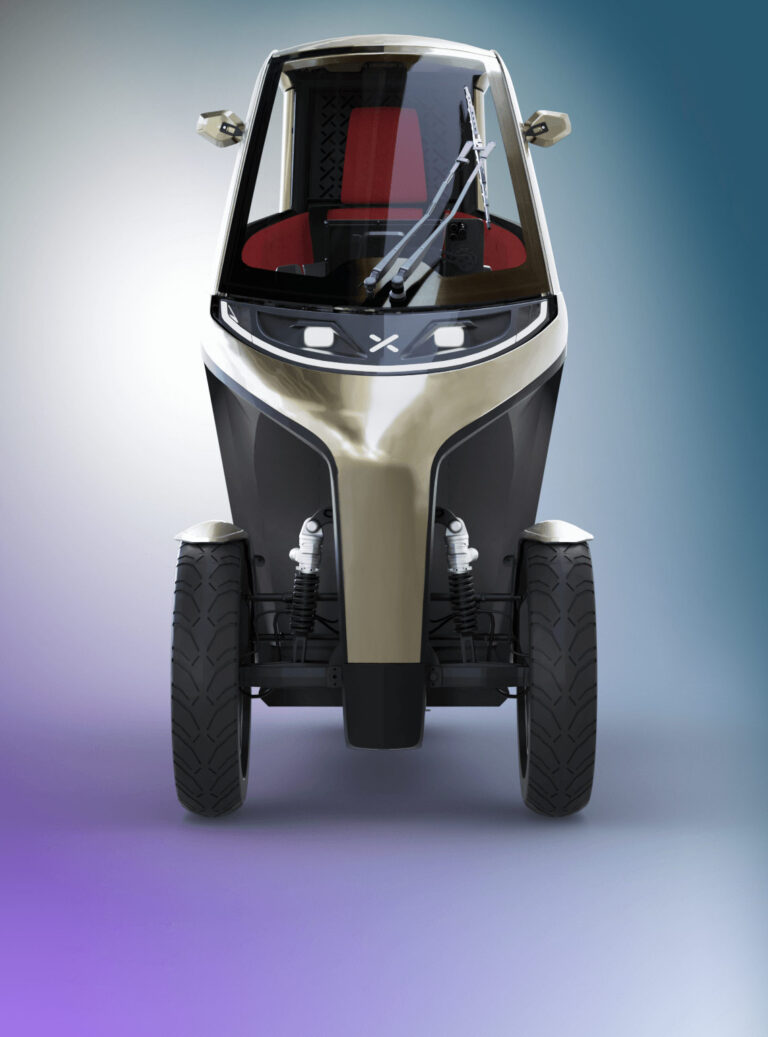
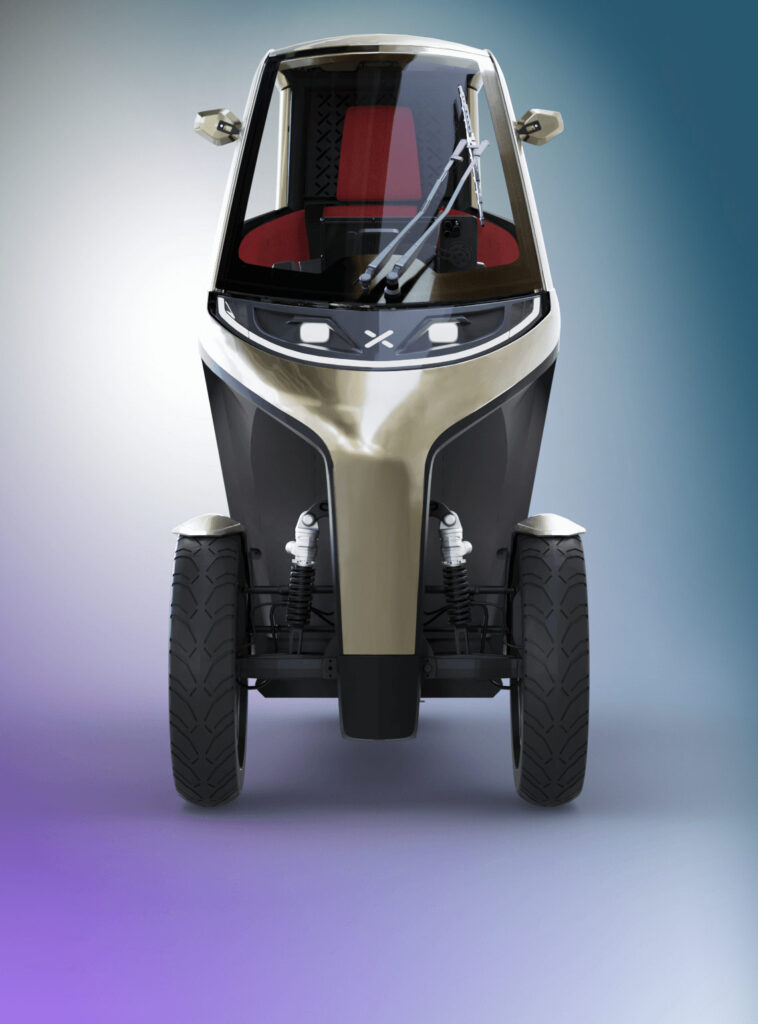
This is the CityTransformer CT-2. It is a road-ready electric vehicle that can change its shape even while driving. It’s part car, part city tool, and fully designed for the way people move today.
Cities aren’t growing wider, but cars have. The shift to electric hasn’t helped much. In fact, many EVs are even bigger and heavier than before. That’s where CityTransformer comes in.
Their idea is straightforward – fix car culture not by scaling it up, but by making it smaller.
Let’s dive in.

CityTransformer started with a single idea – what if cars had to adapt to cities, instead of cities adapting to cars?
That idea took shape in Tel Aviv in 2014, where engineer Dr. Asaf Formoza and innovation strategist Udi Meridor saw the same problem play out every day: streets packed with vehicles too large for the space they occupied. The solution, they believed, wasn’t just smaller cars, but smarter ones.
Their early concept was bold. A vehicle that could expand for stability on open roads and contract to slip through traffic or into tight parking spots. That design became the foundation for the CT-1, their first EU road-regulated prototype.
Support came quickly. Israel’s Innovation Authority backed the team with R&D funding, and in 2020, TIME Magazine listed the CityTransformer among its “100 Best Inventions,” before the CT-1 was even produced and revealed in 2021. That nod opened doors, bringing in pilot programs, investors, and growing interest from across Europe.
But attention wasn’t enough. To scale, the company needed a vehicle that could pass safety standards, meet manufacturing demands, and hit the road in real numbers. So they went back to the drawing board. The CT-1 became the CT-2 – more refined, and fully engineered for production.
They partnered with Segula Technologies for development and brought in European design expertise to get it right. Today, CityTransformer operates from Europe, builds in Italy, and is preparing for market rollout. But the core idea, making cars that fit the city, still traces back to the sidewalks of Tel Aviv.
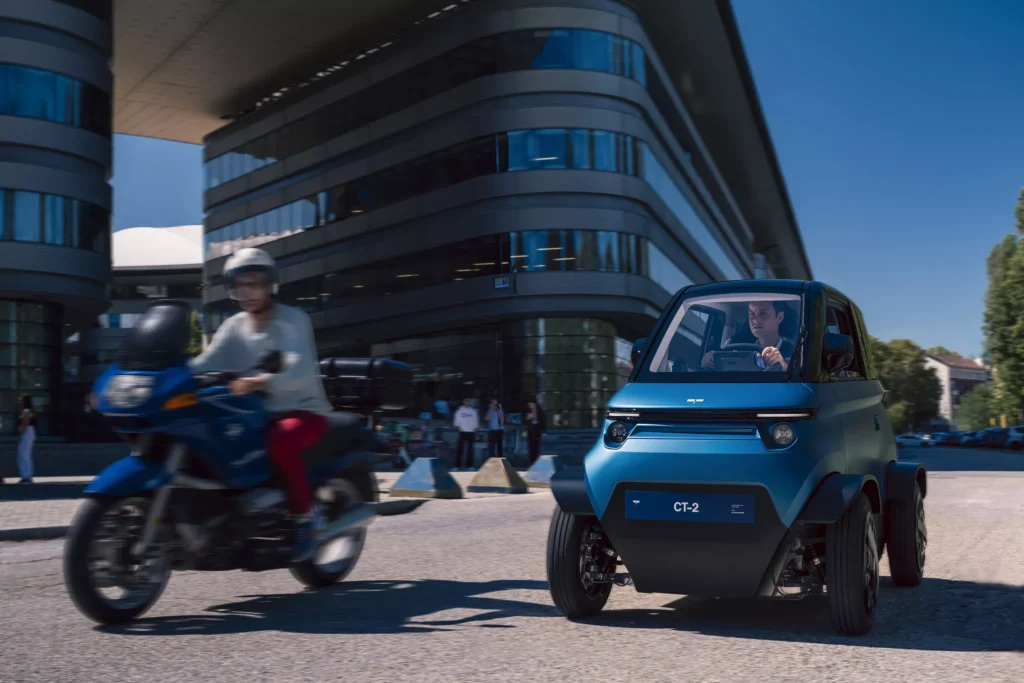
Imagine a car that shrinks in traffic and stretches out when the road opens up. That’s the CityTransformer CT-2. At the push of a button, its body physically narrows, turning a full-width vehicle into something that can slide through congestion or park in a space barely wider than a bike.
In its full stance, the CT-2 spans 1.3 meters, stable and planted for city streets and short highway runs. Need to squeeze through a jam or slip into a tight curbside gap? It tucks in to just 1 meter wide. The entire chassis adjusts on the move, pulling the wheels inward while keeping the car steady and roadworthy at low speeds.
The switch is automatic. Sensors and software handle the transition in real time, adapting to traffic and driver input.
| Motors | Twin rear-mounted motors; 15 kW nominal, 22 kW peak (≈30 hp) |
| Top speed | 90 km/h |
| Range | ~180 km per charge |
| Weight | ~450 kg (excluding the ~110 kg battery pack); L7e quadricycle class |
| Seats + cargo | 2 seats (tandem) + ~350 L rear cargo |
Safety was a top priority. The CT-2 includes reinforced crash zones, electronic stability control, and impact protection far beyond what’s required for its category.
The CT-2 isn’t trying to replace the family SUV. It’s built for the places that SUV shouldn’t be. It’s narrow when it needs to be, solid when it counts, and just enough car for life in a tight, fast-moving city.
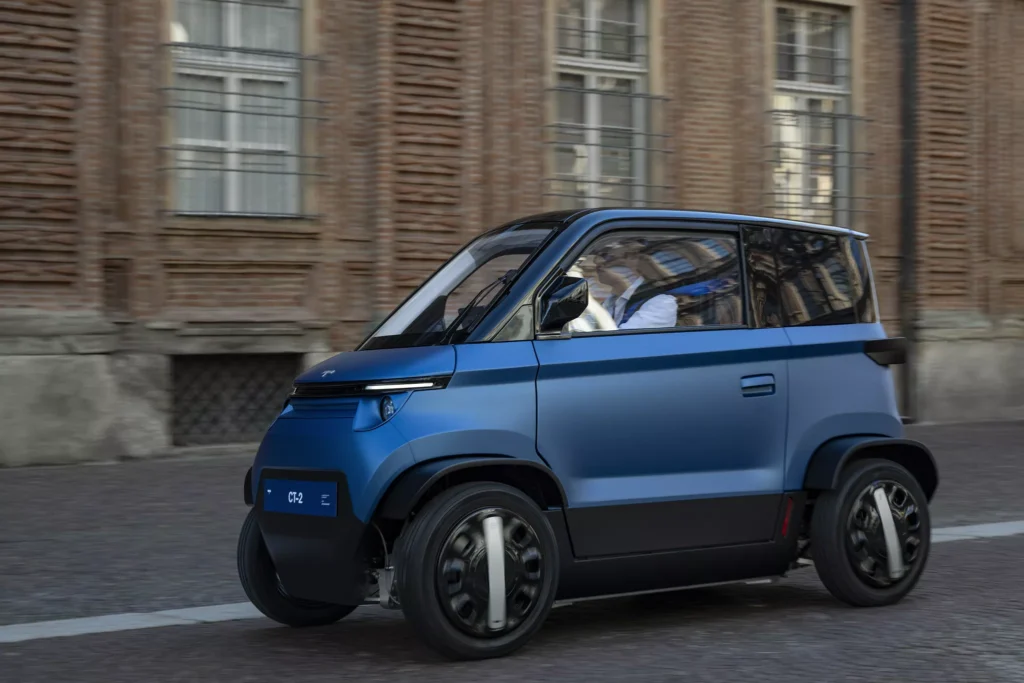
Urban life is full of mismatches. Streets are narrow, but vehicles keep expanding. Parking is scarce, yet most cars are built for highways. The CT-2 was designed to break that pattern.
With its foldable chassis, it adapts to the space around it. In narrow mode (just one meter wide), it can glide through jammed traffic, park head-in at the curb, and fit where others can’t – scooter bays, alleyways, slivers of curbside real estate. It makes use of the spaces most cars ignore.
For drivers, that means less circling, less frustration. For cities, it means fewer blockages, better flow, and a smarter use of what little space exists. Twelve CT-2s can fit in the footprint of just three SUVs. Scale that, and the benefits multiply.
Its compact design also means lower energy use. The CT-2 sips power compared to full-size EVs, and its modest battery (good for 180 kilometers per charge) uses far less lithium and cobalt. That makes it lighter, faster to recharge, and easier to produce in volume. Cities looking to electrify don’t need to upsize infrastructure to support it.
It also fills a critical gap in urban transport. It’s electric and quiet, like a scooter or e-bike, but adds what micromobility often lacks – weather protection, real seats, crash safety. It’s the right size for city life and it behaves like it.
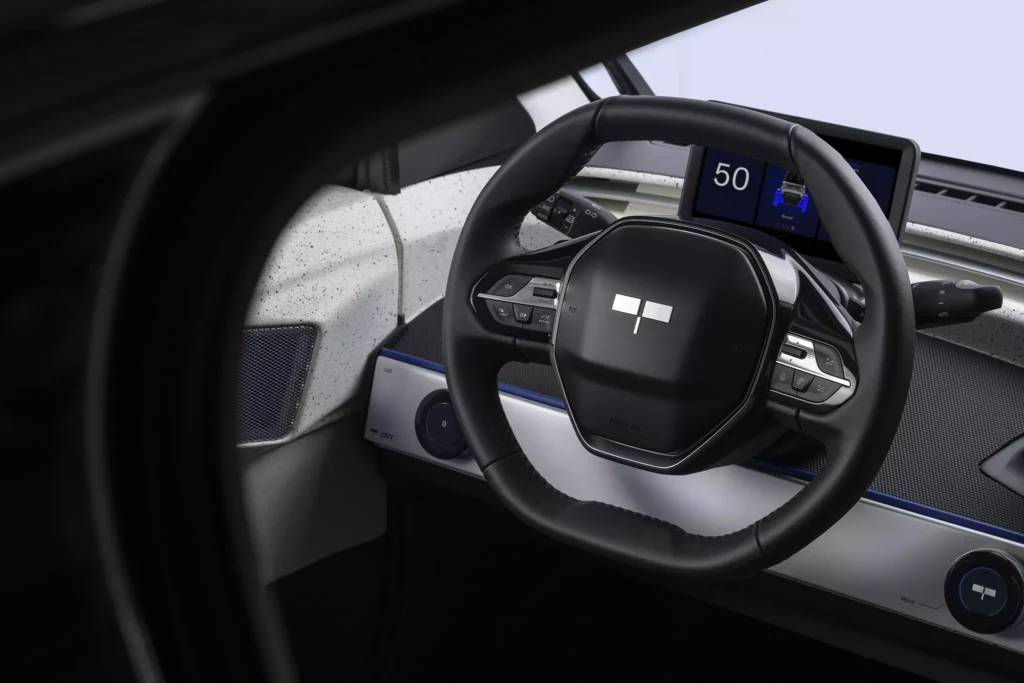
The CT-2 wasn’t built to spend its life in a private garage, but that’s where many of them may end up. While CityTransformer designed the vehicle with fleets and shared use in mind, the response from private buyers has matched that of commercial operators.
The key to that flexibility is software. CityTransformer partnered with Bosch to build it. The system runs on Bosch’s “Ready to Share” platform that includes keyless access, driver verification, real-time tracking, and remote maintenance tools.
For fleet operators, this makes the CT-2 a turnkey asset that’s app-based, easy to manage, and built for scale. For individuals, it’s a city car that happens to be shareable, updatable, and connected from day one.
Whether it ends up on a college campus, in a municipal fleet, or at the curb outside someone’s home, the CT-2 is ready to move, with or without a driver’s name on the title.
CityTransformer isn’t trying to put a CT-2 in every driveway. It’s focused on places where small electric vehicles can make a big difference.
Urban fleets are a natural fit. Municipal agencies need zero-emissions transport for staff and services, something compact enough for narrow streets, but stable, enclosed, and road-safe. The CT-2 checks those boxes.
It’s just as well suited to semi-public spaces. Think university campuses, resorts, business parks, logistics hubs, all environments where vehicles need to be practical, but not oversized. With weather protection, low operating costs, and easy handling, the CT-2 feels built for exactly those kinds of roles.
The CT-2 is a precise answer to very real urban mobility problems, and fleet operators are noticing.
Urban mobility is shifting. Bikes, scooters, and mopeds have shown that people will share vehicles, as long as they’re convenient. But when it rains, when you’ve got cargo, or when safety matters, those options fall short.
That’s where the CT-2 fits. It’s small and electric like micromobility vehicles, but offers the protection and utility of a standard-sized vehicle. Weatherproof, roadworthy, and easy to deploy without the overhead of a traditional car.
And because it was engineered from the ground up for shared use (software, hardware, and support all aligned), it’s more than adaptable. It’s purpose-built for the way cities move now.

CityTransformer doesn’t build cars the traditional way. There’s no giant factory or massive supply chain. The company works with trusted partners to make the CT-2 quickly, precisely, and at scale.
The CT-2 isn’t mass-produced in a sprawling factory. It’s built in Italy by Cecomp, a Turin-based coachbuilder with decades of experience crafting everything from Fiat concepts to custom EVs. It’s a team known for precision, exactly what a vehicle like the CT-2 demands.
An earlier stage of the engineering towards serial production was conducted with the expertise and services of Segula Technologies, a global firm that turns sketches into street-legal machines. Their role was to take CityTransformer’s folding chassis and make it production-ready, safe, and repeatable at scale.
This partner-led model avoids the overhead of factory ownership, while tapping into deep European expertise. It allows CityTransformer to stay lean, build locally, and stay aligned with its promise – fewer emissions, less waste, and just the right amount of vehicle for the job.
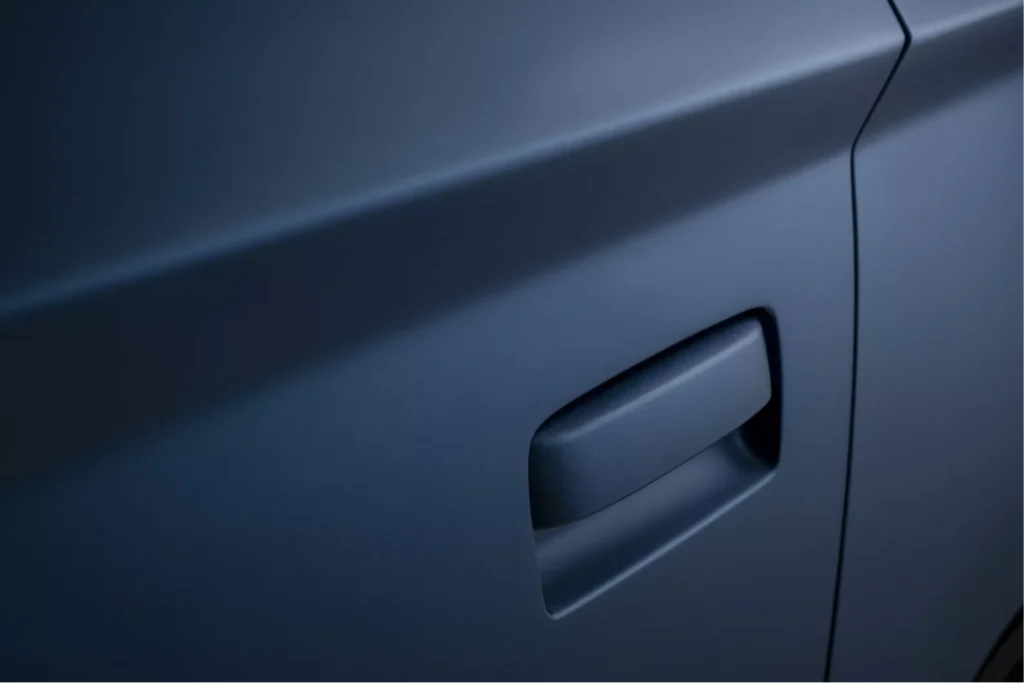
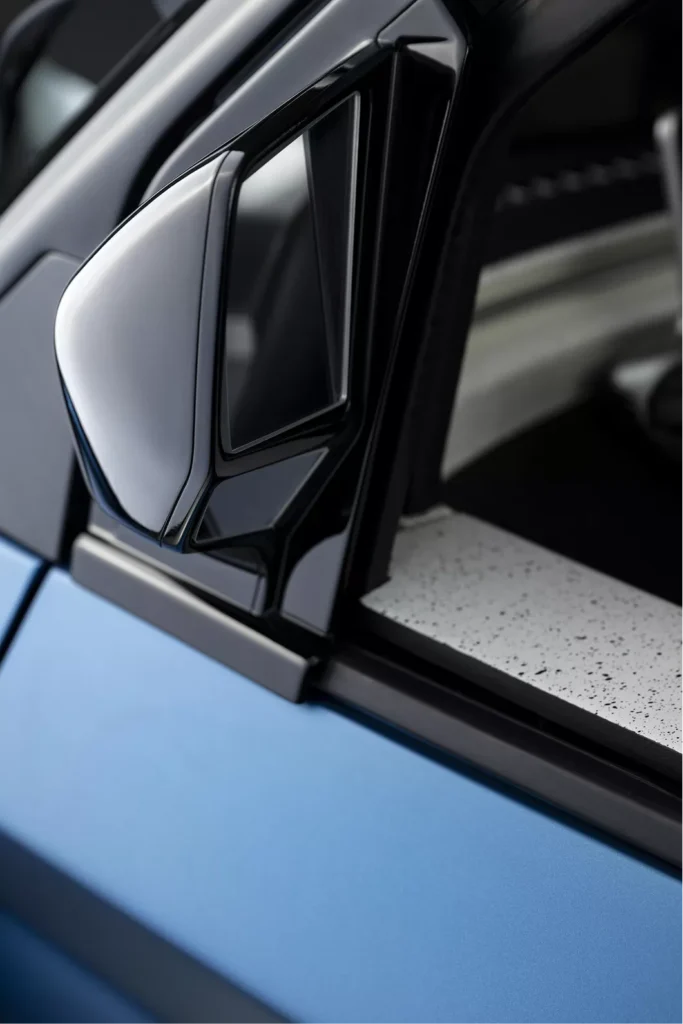
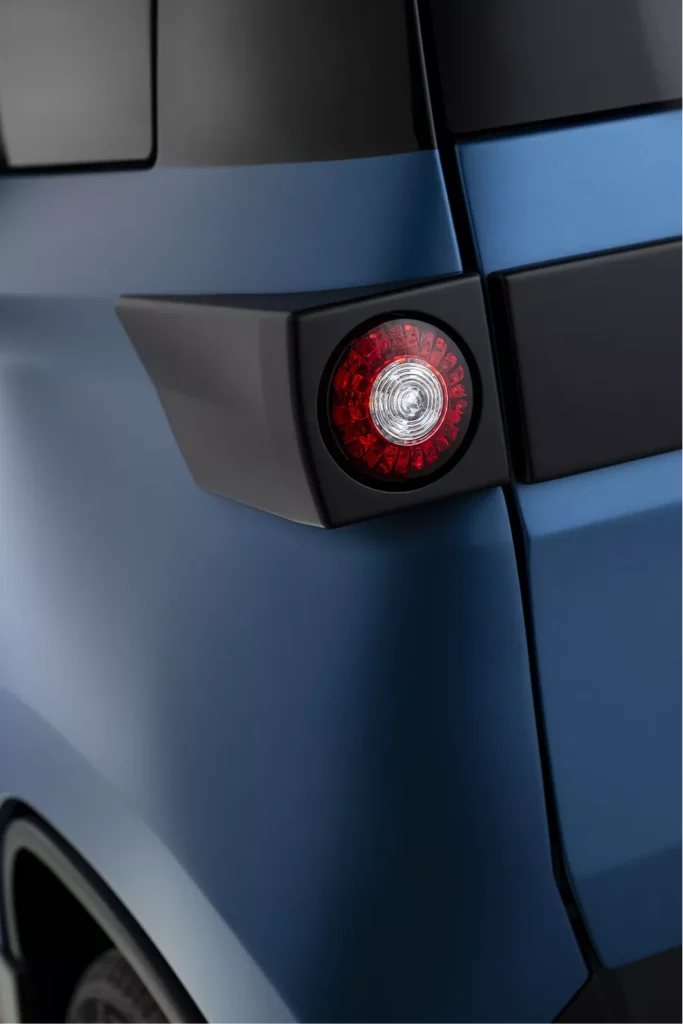
The CT-2 isn’t just for city governments or tech-forward operators. It’s for anyone tired of squeezing full-size cars into half-size spaces.
In 2025 the company secured early distribution commitments for 3,000 of its vehicles in France, Portugal, Israel and the Czech Republic. That balance tells a story, saying this is more than a niche fleet tool. It’s a real alternative for people who want a car built for the scale of modern cities.
For private owners, it’s a second car that fits where others won’t, or for some, the only car they need. It saves energy, parks almost anywhere, and handles city streets without the bulk.
Fleets see it as a lightweight, low-maintenance asset. With Bosch’s fleet software baked in, managing one CT-2 or an entire pool is streamlined with diagnostics, location tracking, and access control all run through one system.
And the use cases keep stacking up. In Israel, emergency teams are testing the CT-2 for quick response in traffic-heavy zones, places larger vehicles can’t reach. In Europe, delivery firms are looking to use it for last-mile drop-offs. And for commuters, it offers the weather protection and cargo room scooters just don’t provide.
All of it points to the same thing, the CT-2 is right-sized for the trips most people take, most of the time.
Launch markets include Germany, France, the Netherlands, Italy, and the UK, all regions pushing for cleaner, smaller, more efficient urban transport. In each, CityTransformer is working with local operators to shape rollouts around real needs, whether that’s municipal services, logistics, or tourism.
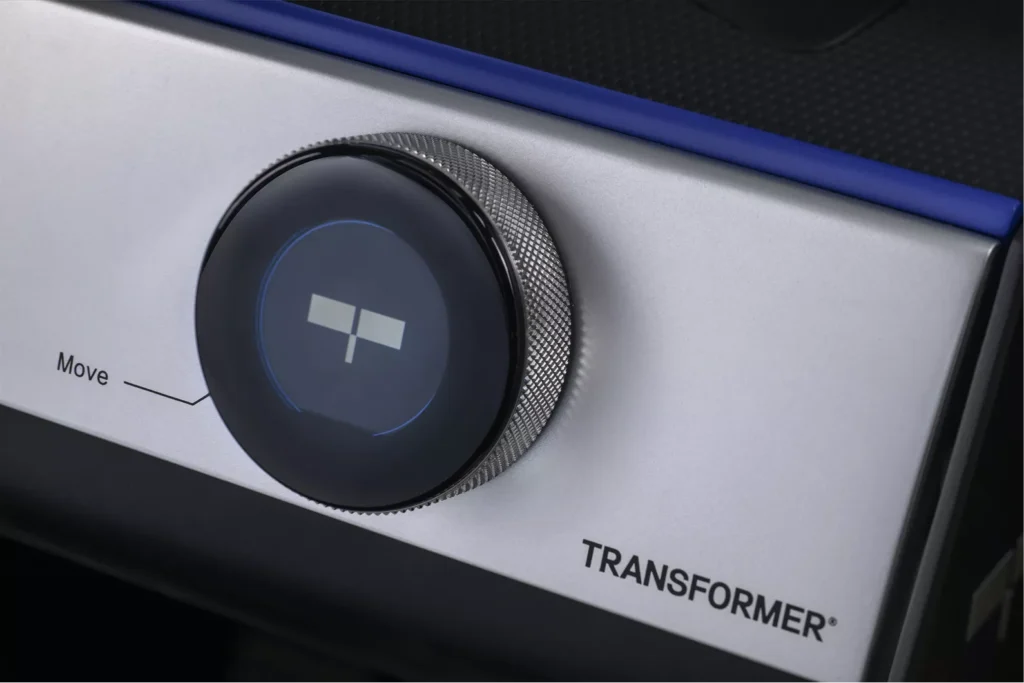

CityTransformer is a founding member of the Microcars Coalition, a group that includes other small EV makers like Microlino, Silence, and Kate. Together, they’re pushing for fairer treatment of light electric vehicles across Europe.
The logic is simple – if these vehicles take up less space, ease congestion, and produce fewer emissions, they should get the same support as larger EVs, or more. But today, they don’t. Despite their clear urban benefits, microcars often fall through the cracks of existing regulations.
The CT-2, for example, is classified as an L7e “heavy quadricycle.” It’s legal on the road, but it misses out on many EV incentives and faces restrictions in some city zones. And not because it’s unfit, but because the law hasn’t caught up.
That’s what the Coalition is working to change. Its members are sharing data, coordinating with city planners, and making the case to EU policymakers that smaller vehicles aren’t a fringe idea, but a practical answer to urban gridlock.
CityTransformer is pushing for updates. They want small EVs included in incentive programs. They want clearer access rules for city centers. And they want cities to recognize that these vehicles are part of the solution.
CityTransformer has ambitious goals and a roadmap that’s beginning to take shape. With design and engineering work complete, strategic manufacturing partnerships in place, and pilot projects underway, the company is now preparing for the critical next step – production.
CityTransformer now plans to begin production of the CT-2 in the fourth quarter of 2027. These first production units are intended for fleet customers, city pilot programs, and early adopters in Europe and Israel.
Pilot testing and demonstrations are already underway in several locations. Tel Aviv, supported by the national Smart Mobility Initiative, is a key early site. Additional rollout partners include municipal and private operators across Germany, France, and the Benelux region.
While the CT-2 is the company’s flagship vehicle, CityTransformer has made clear that additional variants are in development. These include:
The CT-2’s modular platform and proprietary shrinking chassis system allow for new formats without overhauling the core engineering. That flexibility means new models can address more use cases while keeping costs and complexity in check.
To support its next phase, CityTransformer is actively raising a Series B funding round, targeting $20 million. The company has raised over $20M with additional ~ $3M from governmental grants million to date and is backed by eight investors, including Afifi Group, Lubinski Group, ADI Technologies, and Israel’s Ministry of Energy and Water Resources.
These funds will be used to finalize homologation, scale manufacturing, and build out CityTransformer’s fleet service infrastructure. Beyond vehicle sales, the company is exploring licensing opportunities for its folding chassis system to enable other OEMs or urban mobility providers to incorporate it into their own designs.
Most cars force cities to change with wider roads, lost sidewalks, and more parking lots. For decades, urban planning has been shaped by the needs of oversized vehicles.
CityTransformer flips that. It starts with the city as it is, tight, busy, and short on space. Then it builds a car that adapts. One that fits into narrow alleys, slides into small parking spots, and glides through traffic without adding to the mess.
The CT-2 is built for the way people actually live and move today.
When the car adjusts to the street, and not the other way around, we get a city that works better for everyone. It’s a shift from more to enough. From disruption to flow. From taking space to giving it back.
CityTransformer isn’t just building a small car, but developing what it sees as the urban taxi of the future. A vehicle designed specifically for dense cities, short trips, and shared use, rather than long-distance private ownership.
Traditional taxis and ride-hailing vehicles are oversized for their real job. Most urban trips involve one passenger, last less than 10 kilometers, and take place on streets that are already overloaded. Yet cities deploy full-size sedans and SUVs that consume space, energy, and curb access far beyond what’s needed.
CityTransformer flips that logic with their CT-2. The CT-2 platform is being designed as a right-sized urban taxi, optimized for:
Its shrinking chassis allows a fleet vehicle to approach, stop, and park where conventional taxis simply can’t, like narrow streets, historic city centers, and crowded curb zones. In narrow mode, it reduces obstruction for other traffic and improves flow around pickup points, one of the biggest pain points in today’s ride-hailing systems.
From a fleet perspective, the economics are compelling. A smaller, lighter vehicle means:
From a city’s perspective, it means more mobility with less congestion. Importantly, CityTransformer is designing this platform with a clear path toward autonomy and remote operation, once regulation allows. The CT-2’s software-first architecture, drive-by-wire systems, and fleet connectivity are all aligned with future autonomous taxi deployments, starting with driver-operated shared fleets and evolving toward increasingly automated services.
Rather than waiting for full autonomy to arrive, CityTransformer’s approach is pragmatic: build the right urban vehicle first, deploy it with drivers today, and let automation layer in over time.
In that sense, the CT-2 isn’t just a microcar, but a building block for next-generation urban taxi networks that are smaller, cleaner, more efficient, and far better suited to the cities they serve.