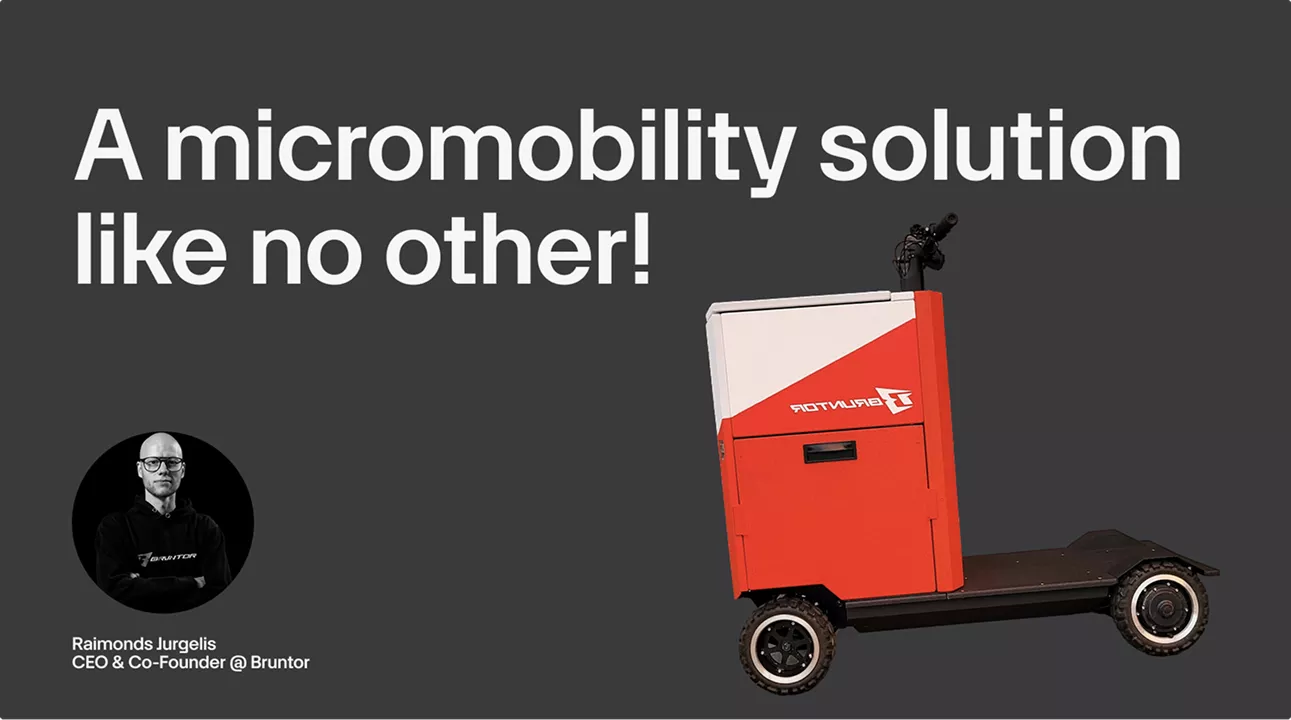
In this Charging Stack podcast episode, we talk with Raimonds Jurgelis, CEO and co-founder of Bruntor, a Latvian hardware startup building electric cargo scooters for last-mile delivery and urban services.
Bruntor’s vehicle is a four-wheeled, stand-up cargo scooter that fits into roughly the footprint of a bicycle but can carry around 400–500 liters of cargo. It is built for short, frequent stops where vans are clumsy and bikes are slow to start and stop. In pilots with Latvian Post, Bruntor’s scooter proved up to four times faster than walking routes, while staying compact, stable, and easy to use for postal workers.
Raimonds shares how Bruntor started with an off-road electric skateboard, went through hackathons and early prototypes that looked like “a potato box on wheels,” and eventually landed its first institutional customers. He also talks about why they chose the hard path of hardware, how they test durability by literally trying to break their own vehicles, and what it takes to sell a completely new vehicle type into slow, risk-averse organisations.
Prefer reading instead of listening? Check out our full Bruntor profile for a breakdown of the business model, use cases, and strategy.
You work in last-mile logistics, city services, or fleet operations
You are exploring alternatives to vans, cargo bikes, and e-bikes
You like hearing the honest side of hardware startups in mobility
In this episode, you’ll learn:
⚡️ How Bruntor evolved from an off-road electric skateboard to a cargo scooter built for work ⚡️ Why stand-up cargo scooters can beat both vans and bikes in dense, stop-heavy routes ⚡️ How Bruntor designs around real workflows by shadowing postal workers at 3 a.m. ⚡️ Why hardware fundraising and sales cycles feel completely different from software ⚡️ How regulations around “what counts as a vehicle” can block or unlock entire markets
Topics covered include
The origin story: building a powerful off-road electric board during COVID and realising the market was elsewhere
The hackathon prototype: welding a handlebar onto the board and using a cat carrier as the first cargo box
Landing Latvian Post as the first customer and proving that Bruntor can be up to four times quicker than walking rounds
Cargo capacity vs agility: fitting bike-like length and width while offering several times the volume of a typical bike
Why stand-up riding and “step on, step off” behaviour matter when stops are 20–100 meters apart
Common misconceptions about scooters in delivery and how Bruntor compares to cargo bikes, vans, quad bikes, and wheelbarrows
Use cases beyond parcel delivery: city park maintenance, hospitals, farms, zoos, retail logistics, and mobile cafés
How Bruntor thinks about durability: hiring someone whose job is to try to break the vehicle in real city conditions
Business model choices: selling vs renting, why test periods of 2–3 weeks are central to conversion, and how custom cargo boxes are designed around tools and parcels
Working with cities and regulators, and why some pilots stall simply because there is no legal category for four-wheeled stand-up scooters
The plan to introduce a simpler entry-level model and possible two-wheel version for markets where four wheels do not fit the rules
Fundraising plans, why hardware investors are cautious, and lessons from a €2,000 trip to plug in one loose cable
What it takes to build a vehicle category, not just a single product, including modular “plug-and-play” attachments and future features like follow-me mode
Subscribe to Charging Stack for more podcast episodes, deep dives, and case studies with the people keeping the future of mobility running. ⚡
Share your love
Filip Bubalo
Researcher & writer for Charging Stack. Marketing manager at PROTOTYP where I help mobility companies tell better stories. Writing about the shift to electric vehicles, micromobility, and how cities are changing — with a mix of data, storytelling, and curiosity. My goal? Cut through the hype, make things clearer, and spotlight what actually works.