
From EVs and batteries to autonomous vehicles and urban transport, we cover what actually matters. Delivered to your inbox weekly.
Milan wakes to the usual mix of rain, scooters, and cars squeezed into impossible gaps. Commuters face the same daily choice – get soaked on two wheels or crawl through traffic in something far larger than the trip requires, aside of options of mass public transportation.
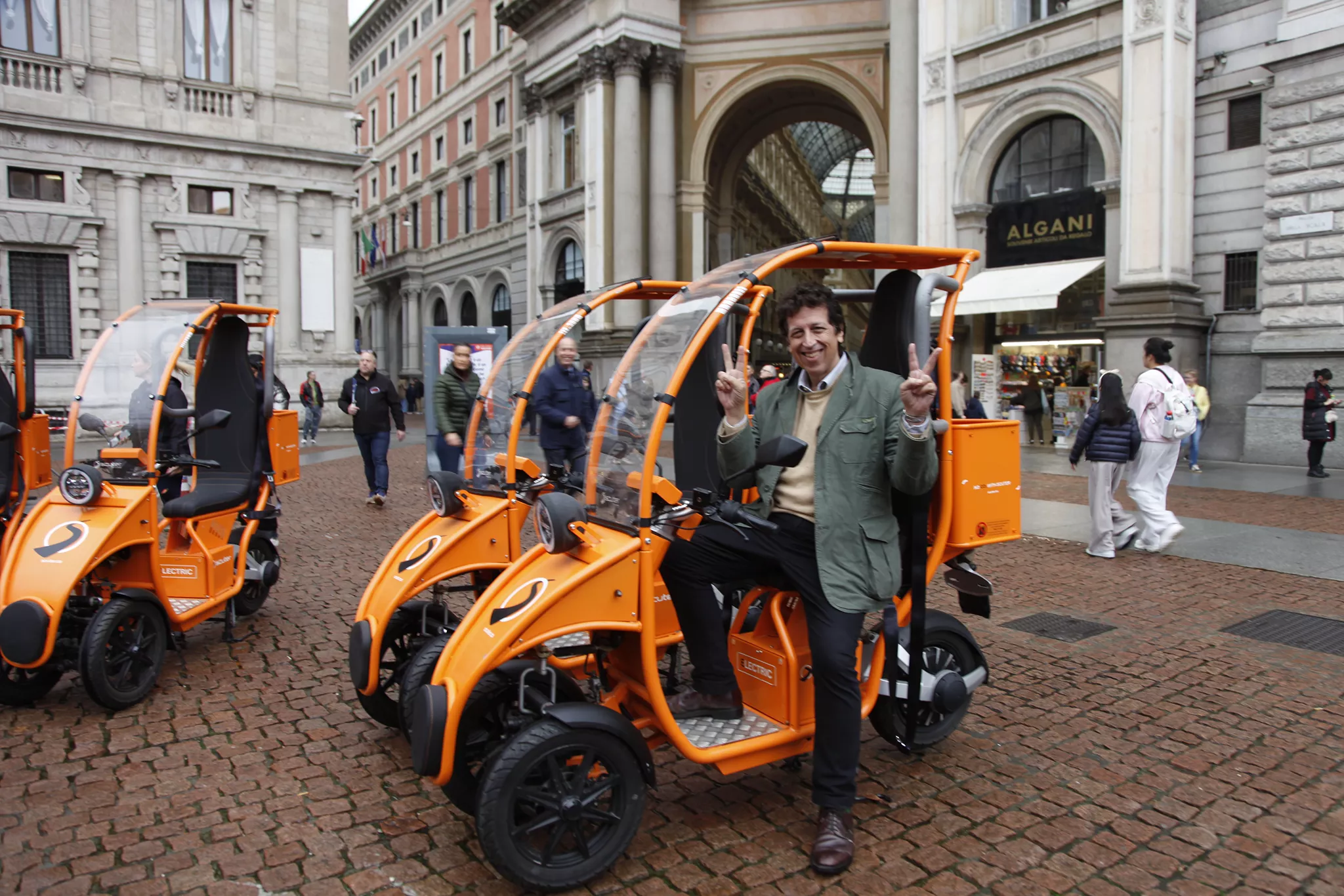
Scuter offers a third option. It’s a small electric cabin on three wheels that you unlock with your phone, ride without a helmet, and park in spaces a car could never use. It’s designed for the everyday routes where a scooter or bike feel exposed and a car feels unnecessary – and it’s made to be used, rather than owned.
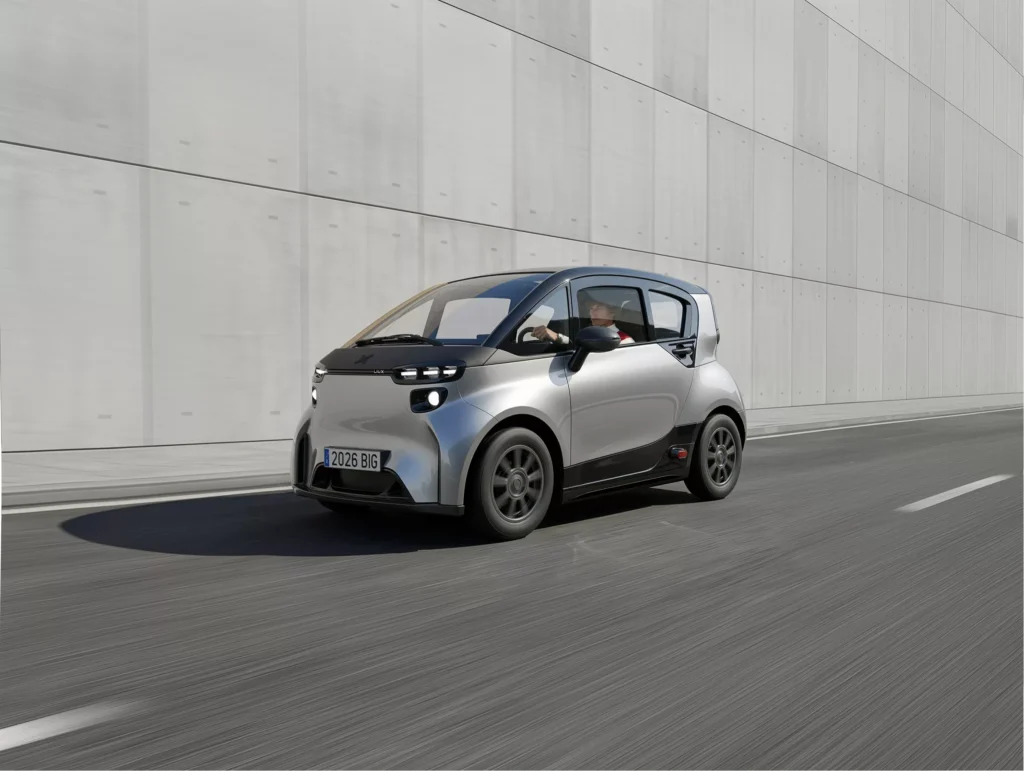
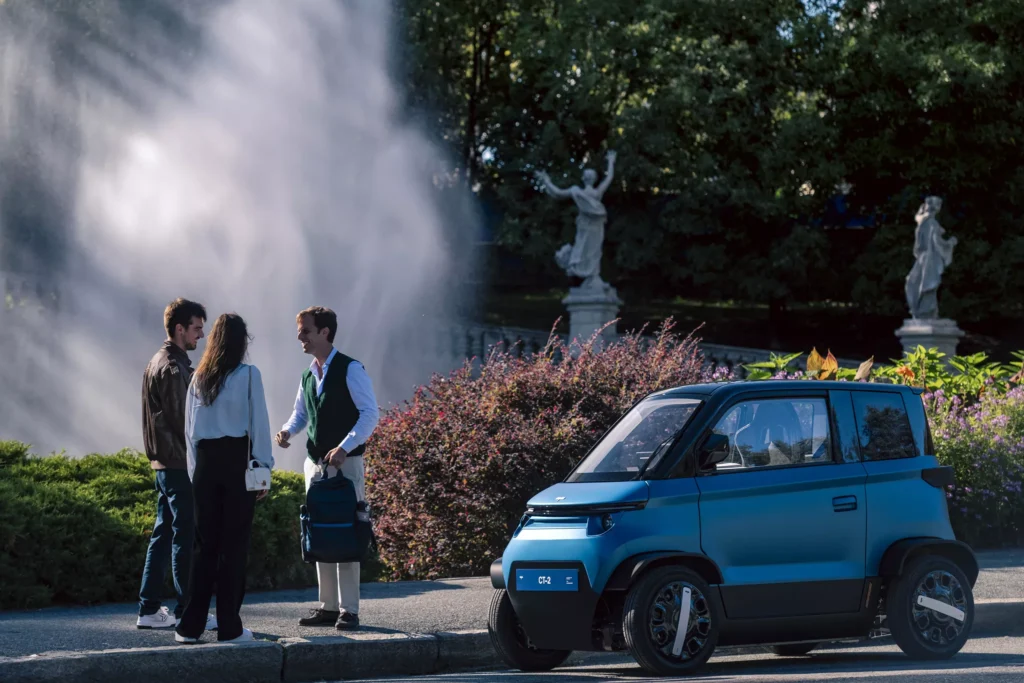
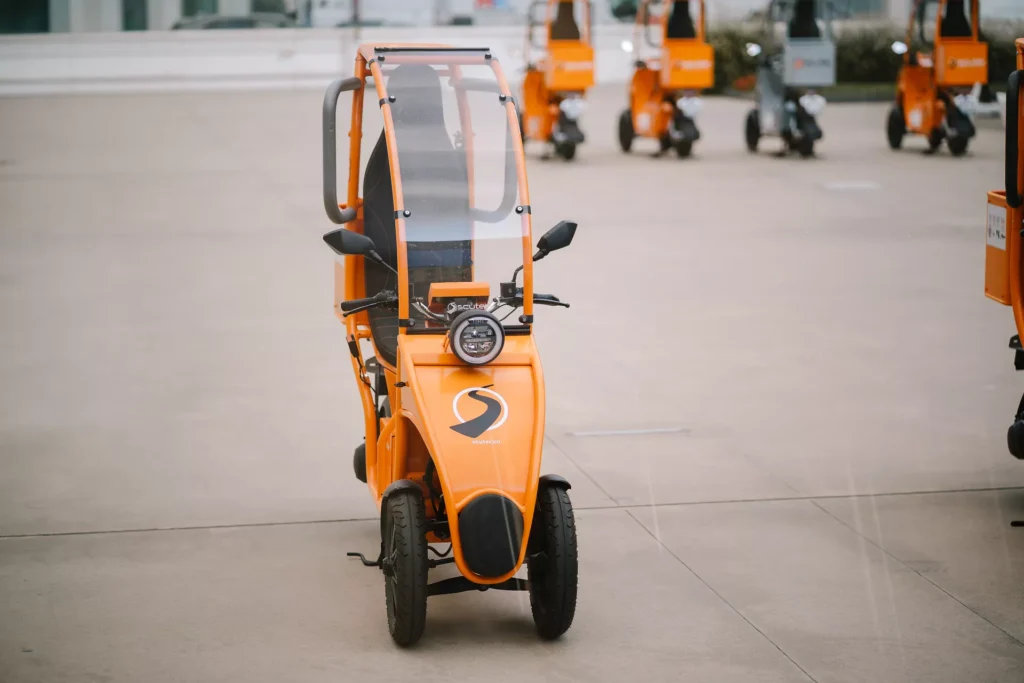
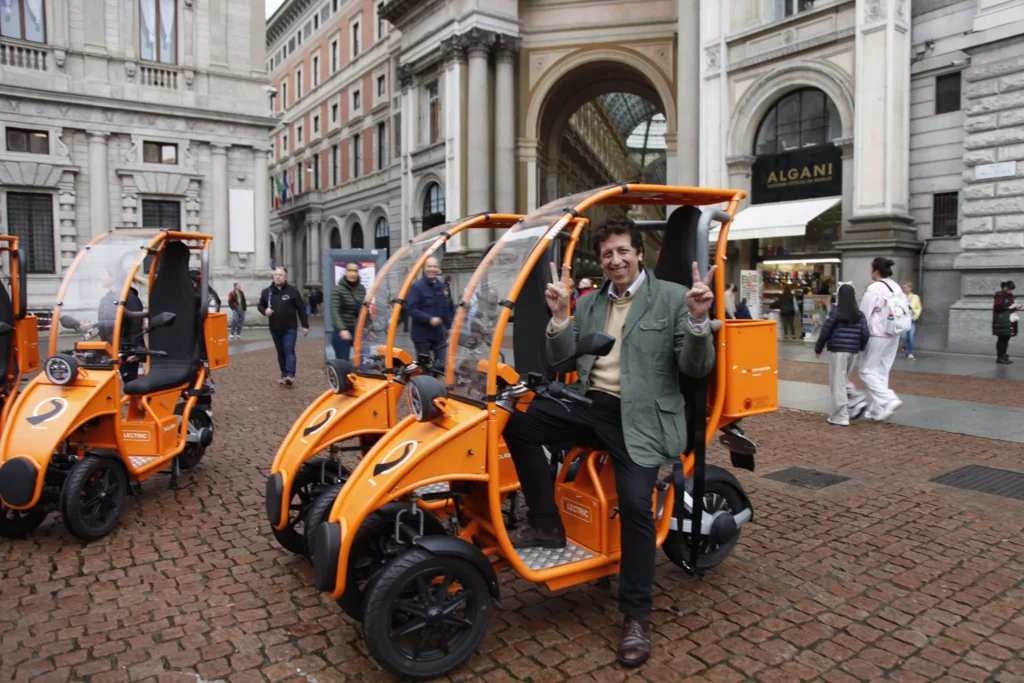
Scuter is a compact electric vehicle built for the kind of trips that fill most days – short, local, and often done in less-than-ideal weather. It has one seat, three wheels, and a low, steady stance that stays planted on rough pavement and tram tracks. You sit inside a small cabin that shields you from wind and rain. With a quick unlock in the app, you buckle in and roll through the city at speeds up to 45 km/h.
Most shared vehicles today fall into two extremes. Scooters, bikes, and mopeds leave you exposed. Tiny EVs feel heavy, expensive, still suffer from traffic crowds and lack of parking spots, and are oversized for how fleets actually operate.
Scuter sits right between them. It handles with the ease of a scooter but feels far more grounded. The cabin keeps you dry. The belt adds a sense of protection. The helmetless homologation – the second in history of motorcycles and mopeds after BMW’s C1 – offers an unparalleled sense of freedom and comfort.
And the three-wheel setup removes the low-speed wobble that pushes many riders away from two-wheelers.
It was never meant to be a personal microcar. It was built for sharing from day one. That’s why the interface is simple, the entry process is fast, the structure is no-frills and rugged, and the vehicle runs on swappable batteries that keep the fleet available across the city.
It’s built for one person and one trip at a time. And it delivers stability and predictability that many shared vehicles still struggle to offer, especially in a city with Milan’s mix of tight lanes, uneven surfaces, and unpredictable weather.
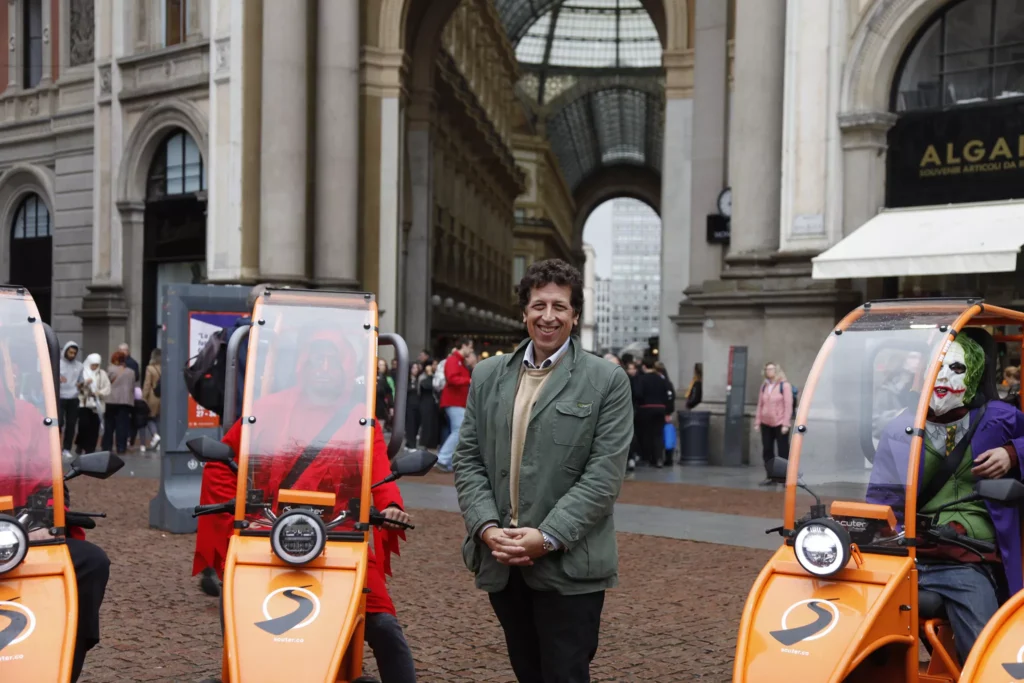
Scuter looks simple and essential from the outside, but the system behind it is built with real city life in mind. It combines a stable three-wheel EV, a fast battery-swap workflow, and an app that manages every step of the ride.
The whole setup is tuned for short-to-medium hops, narrow streets, and constant stop-and-go movement.
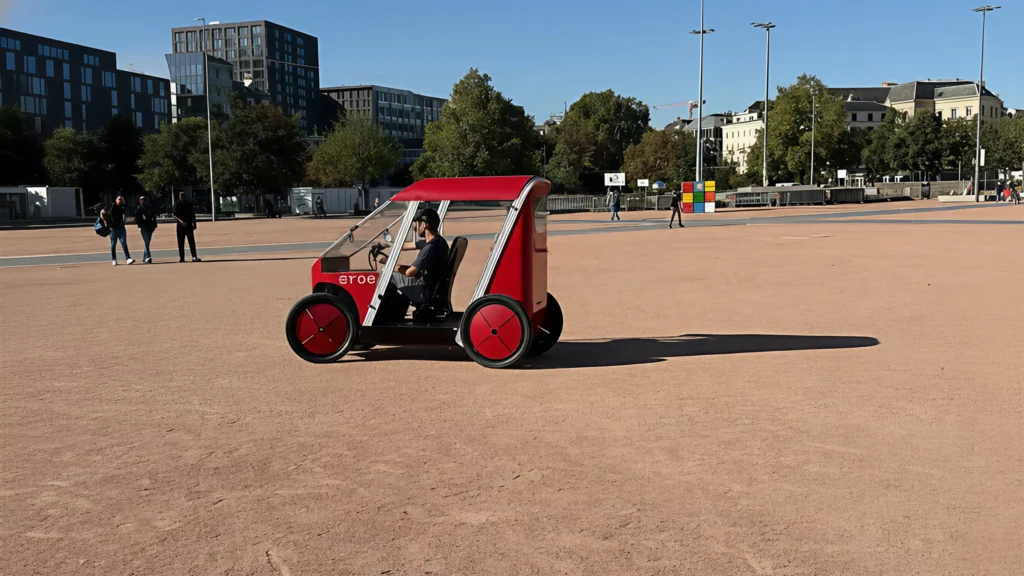
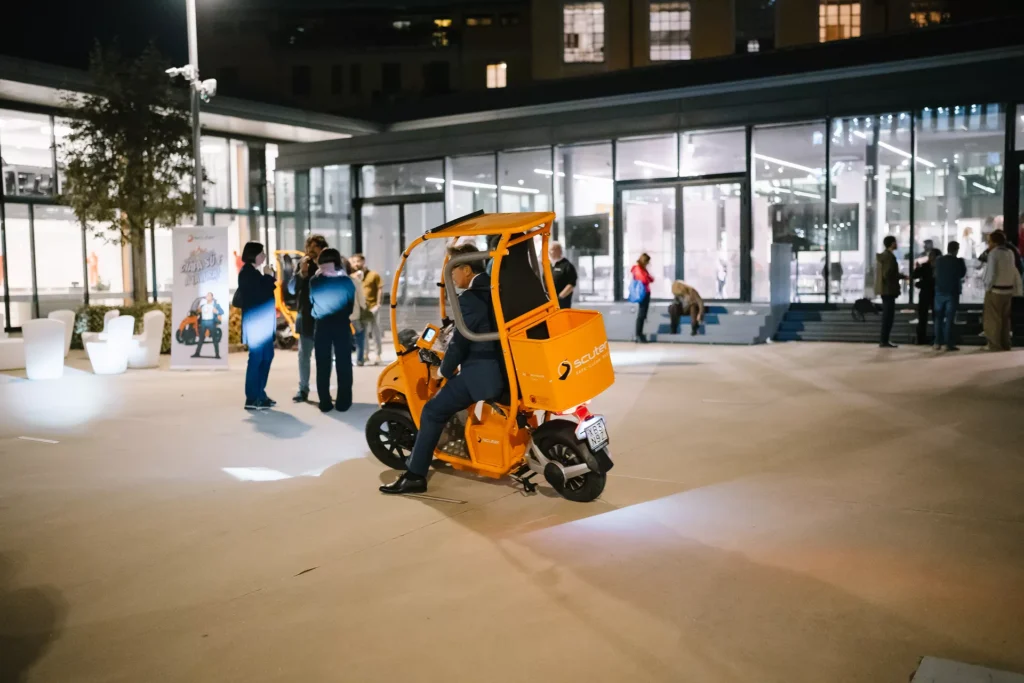
At its core is a compact cabin with a single seat and three wheels. The two front wheels lean and steer, the rear wheel drives. The low center of gravity keeps everything planted on Milan’s cobblestones, tram tracks, and uneven pavement. You sit upright, buckle the belt, and head off at up to 45 km/h.
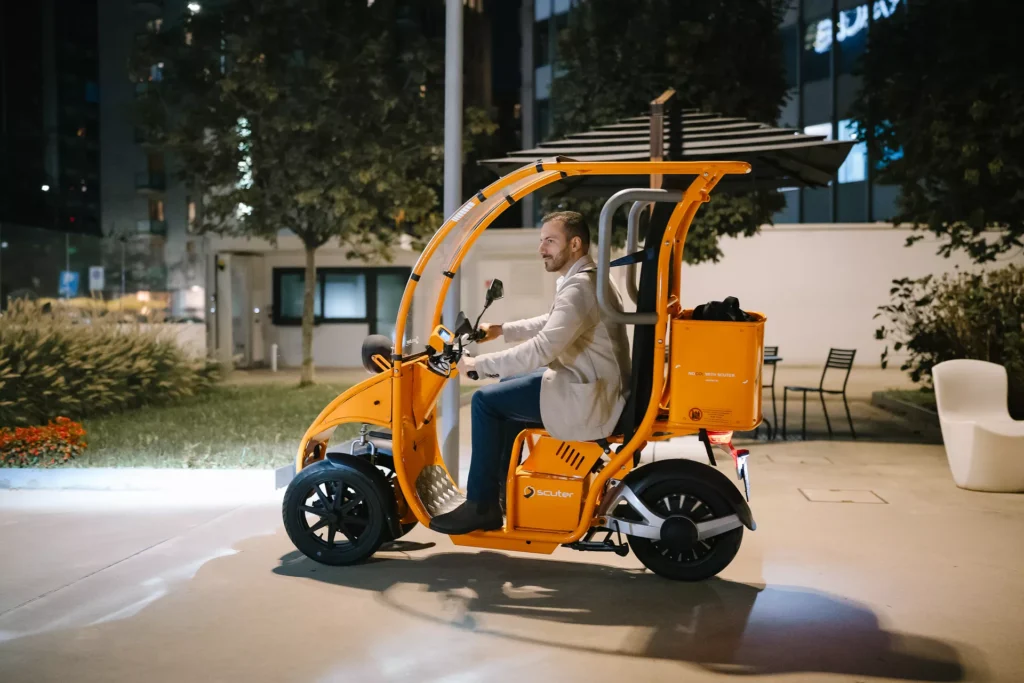
The ride feels familiar if you’ve used a moped but wished it felt more stable. The cabin blocks most of the weather. The belt adds a level of confidence most shared scooters never provide. And the three-wheel layout removes the low-speed wobble that puts many riders on edge. Behind the seat, there’s room for a backpack or grocery bag, enough for most daily errands.
Scuter is small and light. It slips through tight gaps, cuts around stalled traffic, gets in pole-position at red lights, and fits into parking spaces a car wouldn’t even consider. Its brakes and suspension are tuned for city speeds, absorbing bumps without shaking the rider or feeling vague.
This all comes together as a compact, enclosed vehicle that feels steady and intuitive. It’s built for the morning commute, the quick errand, the short ride between neighborhoods, the night movida, all the trips where a car feels excessive and a two-wheeler feels exposed.
Scuter runs on swappable batteries, which is the key to keeping the fleet available all day. When a 100km-range pack runs low, a staff member opens the secure compartment, removes it, and slots in a charged one. It takes only a few minutes, and is done usually during night time.
No one waits for a charge. No rider thinks about range. The operations team handles everything behind the scenes (and, for the future, the company plans a network of swapping hubs where users will be incentivized to drive through). The batteries recharge inside centralized cabinets that handle cycling, monitoring, and storage, which helps keep them healthy over time.
Range varies with terrain and riding style, but the swap system removes range anxiety completely. The app shows you the battery level before you start, and the system warns you if charge is low, so you are not surprised mid-ride.
The app manages the full journey from sign-up to unlocking, payments, invoicing, and support. Riders verify their ID, add a payment method, and confirm licensing. Once inside, a live map shows the nearest available vehicles.
Starting a ride is as simple as walking up, tapping unlock, buckling the belt, and rolling out. The app tracks active minutes and paused minutes. Parking rules and zones appear directly on the map. Ending a ride takes a few seconds – you have to park in a valid area, pull the vehicle on its stand, and tap “End.”
First-time riders see a short safety guide. Before moving off, you are required to fasten the belt and push start button to enable traction – the app and on-vehicle prompts walk you through these steps.
The whole experience feels closer to using a small electric car than a scooter. It’s stable, protected, and predictable.
Scuter’s pricing starts with a simple idea that most city trips are short. Riders hop between metro stops, offices, and nearby neighborhoods, usually within a few minutes. So the system avoids complicated blocks or long commitments. You pay for the time you move, or you pick a small monthly plan if Scuter becomes part of your daily routine.
The base option is direct and predictable:
For occasional riders, this is usually the cheapest way in.
At the time of writing, Scuter runs wallet promotions where top-ups of €10, €30 and €100 unlock €10, €60 and €400 in additional bonus credit under a campaign running through the end of 2025.
These bonuses can push the effective minute rate far below what scooter and moped services offer.
Three monthly plans add even more clarity. All remove the unlock fee and include a daily allowance:
Removing the unlock fee matters more than it seems. Many riders take several short hops, and those fees add up quickly on other platforms.
The pricing only makes sense when matched with real-world habits.
Daily commuters
If you ride 10-15 minutes each way, the Medium or Super Hero plan offers the best value. Add wallet bonuses and the minute cost drops below scooter-sharing levels.
Weekend riders
If you use Scuter now and then, pay-per-minute wins. A 12-minute trip costs €4.08 plus the unlock. It’s more than a metro ticket, but far more stable and weatherproof than a scooter.
Power users
Ride several times per day and the numbers shift dramatically. A €100 top-up bonus integrating a monthly plan can drop the effective rate to under €0.20/minute. At that point, Scuter starts competing with the cost of owning a 50cc moped.
The more you ride, the cheaper each minute becomes. Heavy usage strengthens the economics for riders and the fleet itself.
Scuter also works beyond individual riders.
Companies can set up private employee fleets, giving teams a reliable way to move between offices, client sites, and transit hubs. Large campuses can run a closed-loop system, where vehicles stay on-site and access is limited to authorized staff.
Cities can license Scuter for district-based pilots or full service schemes, testing protected cabin micromobility without adding new infrastructure. This gives municipalities a low-risk way to explore how a small enclosed EV fits into traffic flow, emissions targets, and local mobility plans.
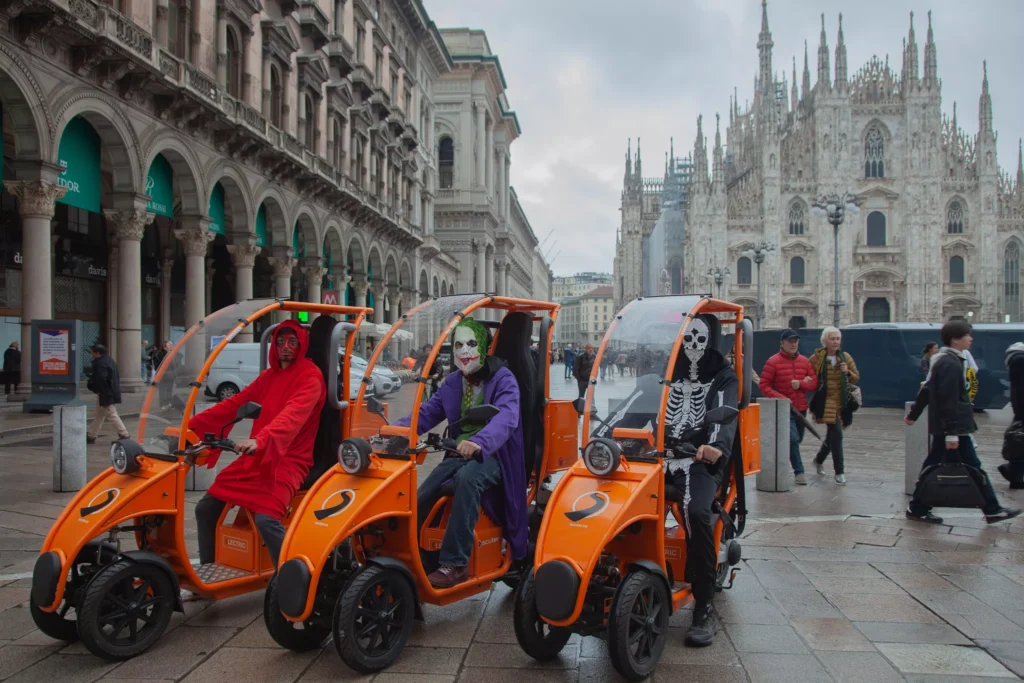
Milan has been the place of initial full-scale launch after many small pilots, and is an easy match for Scuter. The city is dense, fast-moving, and full of streets that were never shaped around large cars. Rain comes often, traffic never fully settles, and scooters fill the space in between. In that mix, a small electric cabin on three wheels feels like something the streets have been waiting for.
The fleet sits across central and semi-central districts, close to the places where short trips happen all day, like metro stations, university areas, office zones, and tight residential blocks. Parking rules mirror other shared systems – end your ride inside approved zones and avoid restricted streets – but Milan’s curbside layout gives Scuter an edge. The city is full of small openings that fit a three-wheeler perfectly.“
The trips themselves are brief. Porta Venezia to Brera. Centrale to Repubblica. These are distances that don’t justify a car and often feel uncertain on a bike. Scuter covers that middle ground with enough speed for normal traffic, a footprint made for side streets, and a cabin that takes weather and safety worries out of the equation.
Riders pick up on that balance quickly. They talk about how steady it feels on pavé and tram tracks, how simple it is to stay dry, and how easy it is to slide into small parking gaps.
Scuter isn’t meant for long commutes or highway runs. It’s for cities with tight districts and constant movement, where most trips last only a few minutes. Milan, like many cities with centuries of history, has thousands of trips like these every day. That’s why this small orange three-wheeler feels like it belongs.
Scuter didn’t appear out of nowhere. It grew from a group of Roman founders who shared a clear idea that cities needed a shared vehicle that wasn’t a scooter, wasn’t a car, and didn’t inherit the weaknesses of either.
They wanted something safer, lighter, and simple enough to operate as a fleet. Each founder brought a different discipline, and together they built a company that sits at the intersection of urban mobility, EV engineering, digital-first user experience, and real-world operations.
Gianmarco Carnovale – CEO
Carnovale anchors the strategy. He’s a veteran of Rome’s tech ecosystem, with years spent building companies, advising accelerators, and pushing for cleaner mobility in Italian cities. At Scuter, he shapes the product and business model roadmap, the fundraising and equity strategy, and manages the policy work that comes with introducing a new vehicle category.
Gabriele Carbucicchio – CFO
Carbucicchio leads administration and procurement. His work spans partnerships, commercial rollout, and the long list of relationships that a company at cross of OEM and shared mobility depends on. Manufacturing and component suppliers, taxes and bureaucracy, operational partners, and HR all land on his desk.
Carmine Di Nuzzo – CDO
Di Nuzzo is the mind behind the vehicle. As an awarded moped and e-bike designer, he designs the cabin, the ergonomics, and the rider experience from the ground up. Everything from the belt system to the handling feel carries his fingerprints. His job is to satisfy riders, mechanics, and fleet managers at the same time.
Luca Ruggeri – CTO
Ruggeri handles the software platform, hardware, and electronics. He oversees the systems that keep Scuter in service day after day: the drivetrain, the battery architecture, the telematics, the internal electronics, the app and the backend suite. Reliability and UX are the heart of shared mobility, and Ruggeri builds that backbone.
The team has been at this since 2015, advancing through multiple prototypes, navigating regulation, and fine-tuning a design that could survive daily city use. Milan’s fleet is the product of that long, steady climb.
Designing a new electric vehicle to be homologated and license plated is one challenge. Turning it into a shared mobility system that a city can rely on is another. It takes hardware, software, operations, and enough capital that lets all three mature at the same pace. Scuter’s funding story reflects exactly that mix of early believers, institutional partners, and public programs that treated the project as part startup, part urban infrastructure.
The company’s earliest support came from close to home – friends, family, and a group of early angel investors. A campaign on Mamacrowd added momentum and gave Scuter enough capital to build its first prototypes and a working version of the vehicle–platform–app system. It was the phase where the idea started taking physical shape.
The next chapter brought in a different class of backers. Several major Italian institutions stepped in, each covering a different piece of what a mobility rollout requires:
This blend of equity, grants, and structured financing gave Scuter the foundation to refine the Mark V vehicle, get it Europe-wide homologated, build its first operational fleet, and prepare for launch in Milan. It was the moment Scuter shifted from prototype to product.
Scuter raised an undisclosed seed-extension and remains a venture-backed company operating so far at the scale of a single metro area, pursuing its product-market fit and related metrics, before opening a continental, and hopefully a global, network.
Milan today is the proving ground, the place where utilization, reliability, and fleet economics are measured before any expansion. It is the test case for whether a compact, protected EV can become a meaningful part of a city’s mobility system.
Scuter’s blended model makes easier and ligther business which used to be capital-intensive by nature. Even so, its funding mix gives it structure, breathing room, and a path to grow gradually. The next phase will almost certainly focus on raising further capital, strengthening city partnerships, and scaling the fleet beyond Milan.
Its funding trajectory shows a focused ambition – institutions see value in a protected, cabin-style EV built for the kinds of dense European streets where scooters and cars each fall short, and where this first-of-a-kind vertically integrated approach might replace ICE cars and expensive car-like EVs.
Scuter isn’t trying to replace one type of vehicle. It fills the open space between several with a one-size-fits-most approach. In most cities, riders bounce between options that are either too exposed, too heavy, or too awkward for a quick three-kilometre trip. Scuter lands in the middle with a simple promise that you can stay dry, stay steady, and move through the city without the hassle or weight of a full car.
E-scooters and shared bikes shine on very short hops. They’re cheap, easy to unlock, and effortless to weave through traffic. Their weak points are obvious – no protection from rain, shaky handling on broken pavement, a riding style that doesn’t suit everyone, and severe risks where bike lanes are rare.
Scuter removes the two issues that stop many people from choosing scooters in the first place – weather and stability. The cabin shields you on wet days. The three-wheel stance stays calm on cobblestones and tram tracks, where scooters often feel unsettled. Its top speed of 45 km/h puts it above bikes but still firmly within urban norms.
Parking follows the same logic as other shared mobility systems – stay inside marked zones and avoid restricted streets. Bikes remain more flexible here, but Scuter fits into tighter spaces than most people expect.
On price, scooters remain the cheapest option for occasional and very short range riders. Scuter becomes a better deal only when you ride often. But the ride itself isn’t comparable. Scuter offers protection, steadiness, and a more predictable experience, all the things shared scooters will never fully deliver.
Mopeds solve some real problems. They add range, they feel stable, and they can cover the city quickly. Then they add new friction – hunting for a clean helmet, adjusting straps, hoping the size fits, and stepping into traffic fully exposed to wind, rain, and co-existence with cars and buses.
Scuter removes all of that. You sit on a chair, buckle the belt, and go. No helmet or gear needed, no juggling with visors. And safer exposure to much-heavier vehicles driving aside. For many riders, that alone is the deciding factor.
Mopeds also carry a more “serious” feel. They are heavier, faster, and can be intimidating for beginners. Scuter’s 45 km/h limit fits neatly into traffic-calmed streets and feels easier to manage. Operationally, it’s simpler too. Mopeds require helmet checks and more maintenance. Scuter’s enclosed design, robustness, and swappable batteries make the fleet easier to service and keep in circulation.
For anyone who avoids mopeds because of weather, helmets, or the motorcycle-like feel, Scuter becomes the relaxed, low-stress alternative.
Micro-EVs offer full cabins and that sense of being in a “proper vehicle.” They also come with weight, cost, and a dependency on public charging. These vehicles are engineered for ownership and carry regulatory requirements that make them less flexible for sharing operators. Plus, they suffer from traffic crowds similar to any larger car.
Scuter is built on a different philosophy. It stays lighter, smaller, and fleet-native. The three-wheel setup keeps manufacturing simpler, snake-around in traffic and parking easier, and operational costs lower. Swappable batteries mean no public chargers, no downtime, and no need to negotiate street-side infrastructure.
Compared to the Citroën Ami, Scuter takes up far less space and uses fewer materials. Compared to Microlino, it trades long-range travel for true ultra-local convenience. And compared to the Twizy, it adds an even smaller cabin and more agile driving style in traffic while having a more approachable learning curve.
Each of these micro-EVs solves a different problem. They behave like very small cars. Scuter doesn’t try to. It’s a single-purpose urban pod, built for the short-to-medium, dense, everyday trips where agility, uptime, and low running costs matter far more than range or consumer automotive frills and features.
Scuter fits Milan well, but growing a new vehicle category is never straightforward. Shared mobility runs on tight margins, unforgiving logistics, and rider habits that rarely shift overnight.
Scuter brings real strengths like a protected cabin, swappable batteries, and a compact size that suits city life. But it also faces challenges that will shape how far and how fast it can go.
Scuter fits cleanly into the EU’s L2e category, but the rules for how L2e vehicles are treated differ significantly between cities. Road access, parking, and shared-fleet permits varies at the municipal level, not the EU level. This inconsistent local framework – to be applied to all shared mobility operators – is what complicates expansion, not the EU category itself.
Milan’s rules align with Scuter’s design. Another city, even if it cannot overpass EU homologation laws and national driving laws, might require additional technical or service features. Each variation slows rollout and adds friction to expansion. Scuter’s advantage in facing these challenges by their unique company nature being both the vehicle maker and the mobility service provider.
Shared mobility works only when vehicles stay in motion. They need to be rented often, parked responsibly, and serviced before issues appear. Scuter isn’t just competing with shared bikes, scooters, and mopeds. It competes with cheap used cars, dependable metro lines, and private bikes that cost nothing to operate.
Scuter’s pricing structure rewards consistent riders, but attracting and retaining enough of them is the ongoing challenge. Hardware fleets also lose value the moment they sit still. Idle vehicles become pure cost. Scuter’s cabin adds comfort and safety, but daily utilization is what determines whether the model scales.
Behind every simple app experience is a complex operation. Batteries must be swapped on schedule. Vehicles need to be rebalanced across the city as demand shifts. Maintenance teams have to anticipate issues before they interrupt service.
Swappable batteries remove charging downtime, but they increase pressure on logistics teams. A larger fleet will magnify everything, what works well and what breaks under stress. Scuter’s will to decentralize services on end users is a possible solution.
Milan is a friendly testbed. It has dense streets, strong public transport, and a population already used to shared mobility. But success there does not guarantee an easy copy-paste elsewhere. Each new city brings a different mix of rules, expectations, and political climate.
To expand, Scuter needs more than a polished vehicle. This means new municipal partners willing to pilot a new category, adjust local rules, and integrate Scuter into their mobility plans. These agreements take time and require as much diplomacy as engineering.
Scuter is simple to ride, yet still unfamiliar at first sight. New formats always take time to earn trust.
Some riders feel comfortable on the first trip. Others need a few sessions before the sensation becomes natural. Car-first commuters may take longer to switch from something with four doors to something that seats one. Consistent availability, clear onboarding, and a steady ride experience are what turn curiosity into repeat use.
Cities are reshaping themselves in slow, steady steps. Streets are narrowing, speeds are dropping, and the push to cut emissions grows stronger each year. In that environment, the full-size, owned car feels oversized for most daily trips, while many riders still hesitate to rely on exposed two-wheelers. Scuter slips into the space between those extremes. It is sized for the city rather than the highway.
Its design makes a simple point – most urban trips don’t need much. Not four seats. Not a wide footprint. Not the weight or complexity of a traditional vehicle. They need something small, predictable, and protected enough to feel comfortable in all weather. A compact cabin with good maneuverability meets far more daily needs than people expect. And when that cabin sits inside a shared fleet, the impact compounds. This all leads to fewer private cars, less pressure on parking, and more useful trips per vehicle.
Milan shows how well this works. Right-sized mobility doesn’t have to be bold or futuristic. It has to be practical, weatherproof, easy to adopt, and convenient. Scuter checks all those boxes. It feels steadier than a scooter, simpler than a moped, and far lighter than a microcar. It gives people a way to leave their car at home without feeling like they’ve stepped down and save more time doing it.
Shifting away from oversized vehicles won’t happen in a single leap. Change arrives through small, sensible additions that match how cities actually move. Scuter is one of those additions that’s built for one rider, one route, and the short, frequent trips that fill most days. If more European cities choose to test and support this format, a meaningful share of daily travel could shift toward compact electric cabins.